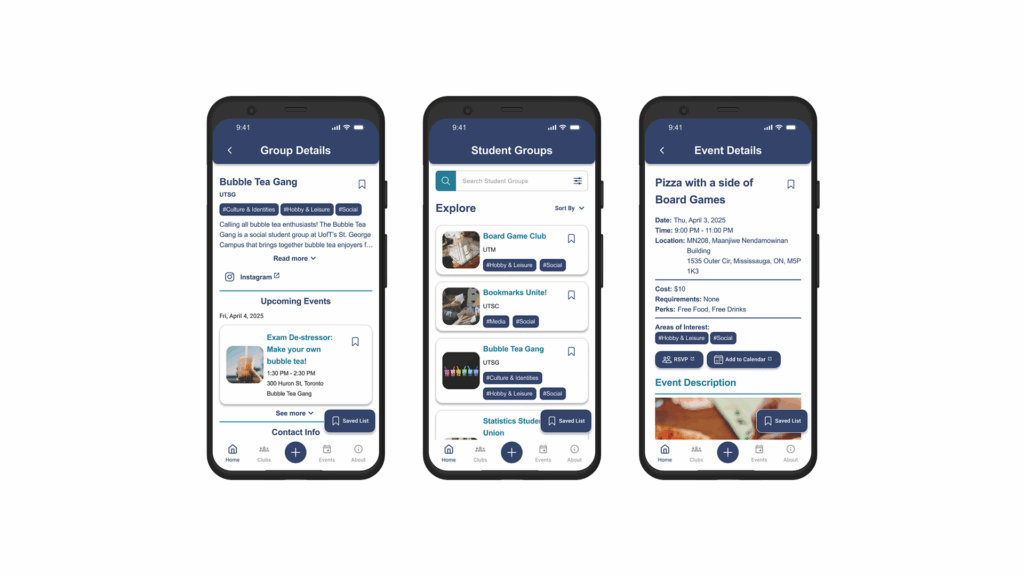
UofT EventNest
Designing a mobile app to help UofT students engage with campus clubs and events they are interested in.
- Identified the needs of UofT students and their expectations regarding attending club events.
- Designed an interactive prototype that matches UofT branding and adheres to accessibility design principles.
- Communicated with the client on a regular basis to manage expectations and align goals.
- Based on a concept provided to the University of Toronto through a hack-a-thon.
Project Details
Client
University of Toronto St. George | Mobile Application Development Lab (MADLab)
Sector
Community and Social Networking
Platform
Mobile
Team
- Russell Lau
- Winny Peng
- Francesca Cheng
- Chloe Ho
My Role
- Led weekly communications with client and organized meeting notes
- Organize group meetings and facilitated discussions
- Conducted user interviews with a variety of UofT students
- Designed the search, date filter, and event page interactive prototype
Skills
Semi-structured user interviews, design system, prototyping, client communication, mobile app design, synthesizing data
Tools Used
Figma, Figjam, Google Suite
Results
After twelve weeks of extensive research and design work, My team and I created an interactive prototype that connects UofT students with campus clubs and events. This was then handed off to the UofT MADLab team to be implemented as part of the official university mobile application.
Users can
- Look up current and future club events at all three campuses
- Search and filter for specific clubs that match their interest
- Easily look up club or event details
- Save clubs or events for future reference
Project Context
This case study was the result of a group capstone project as part of the Master of Information program where students were assigned real clients to create UX-related deliverables. My group was assigned the University of Toronto’s Mobile Application Development Lab(MADLab) as our client. We were tasked with creating the user interface mobile designs for UofT’s new EventNest feature. This feature would provide students with a hub in which they could discover new clubs and events happening on campus. As this was originally a concept created during a UofT hack-a-thon, UofT needed us to create a mobile design that fits its branding style and would be accessible to all students from all three campuses.
Research
Secondary Research
We began by conducting secondary research to establish a foundation of what could be done with our deliverables. Part of this process involved conducting a competitor analysis of other university application. We analyzed apps from Rutgers, Penn State, and Queen’s university. Our overall finding from the competitor analysis was that while these apps do support their students, they only provide basic event features and did not allow the student to personalize their experience.
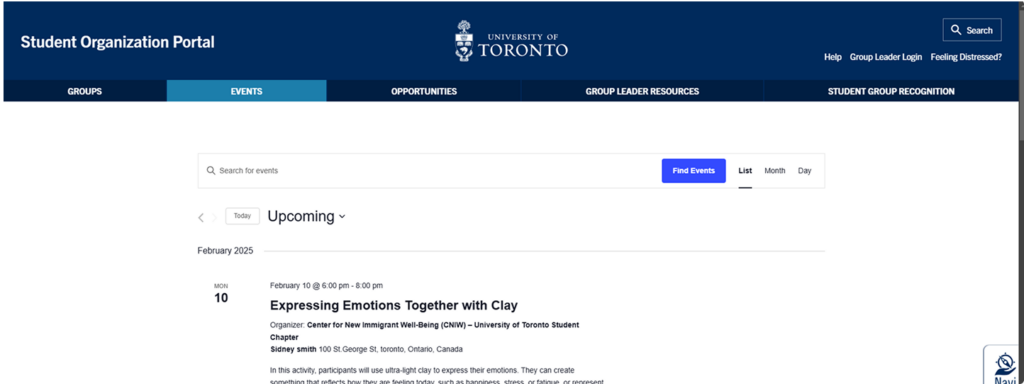
Another part of this research was reviewing already existing practices for event management and promotion used by UofT clubs. At the time of research, students only had a few limited ways of discovering clubs and events. Other than monthly newsletters and social media, there is a Student Organization Portal. However, the portal is infrequently updated and does not properly reflect all potential events happening on campus.
Primary Research: Survey
To gain a better understanding of how both UofT students and clubs interacted with each other, a survey was created and sent out that asked basic question regarding discovering club events. Only registered students from either UTSG, UTM, or UTSC could participate. During the screening, respondents could identify themselves as either non-club or club members. This would change the survey to ask more relevant questions about their participation and event discovery.
In total, we got 50 respondents with the primary demographic being upper year graduate students. Some interesting finds include:
48% of non-club members do not attend any campus events
69% of non-club members rely on emails/newsletters for information
52% of club members rely on Instagram for event information
Primary Research: User Interviews
As part of our primary research, we conducted semi-structured user interviews to gather context rich qualitative data. This would help us dive deeper into the potential pain points and opportunities we could address with our design.
To better address our target audience and gain a more comprehensive perspective, I proposed that we should interview club executives and potential students in addition to UofT students. Adding onto that, I also pushed to have at least two students from each of the three UofT campus participate in the user interviews.
Each session were 30 minutes long and were tailored depending on their demographics (Club Executive, UofT Student, Potential Student). The session consisted of questions regarding:
- Demographics
- Current event discovery and behaviours
- Technology usage for event discovery & management
- Pain points and opportunities
In total, we interviewed 12 participants.
Five Club Executives
To learn how clubs or student groups promote their events and their communication methods.
- 4 clubs of which 2 host multi-campus events
Six UofT Students
To understand how UofT students discover campus events and what influences their decision to attend or not.
- 2 students from each campus representing undergraduate and graduates.
One Potential Student
To discover what sort of expectations potential students may have going into UofT and explore opportunities to support their first year regarding campus events.
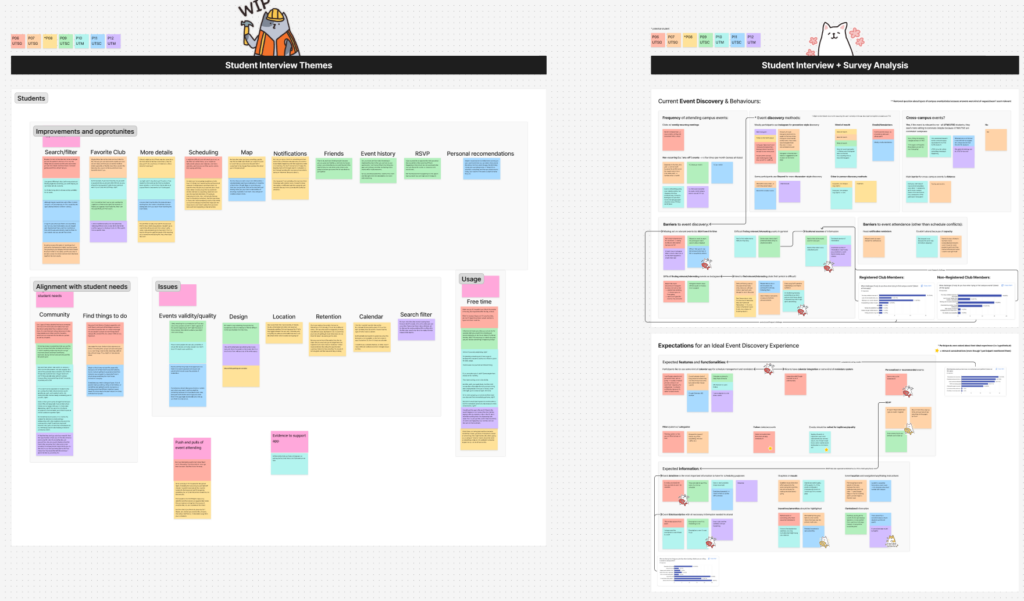
User Interview Findings
After synthesizing our interview research data, we found that:
Opportunity
After presenting our findings with our client (MADLabs), we discussed potential opportunities that EventNest could address and created a list of features to include into our design. To narrow our design scope, my team and I voted on what we thought were the most feasible and impactful features to include in our design.
General Features
- Event filter system w/ categories
- Reminders & Notifications
- Event attendance history
Event Details
- Expanded event titles and descriptions
- Highlight Incentives/amenities
- Event location and navigation/wayfinding
Personalization
- Personalized event recommendation
- Event Scheduling/Calendar
- Follow student groups and organizations
- Ability to RSVP events
Design: Round One
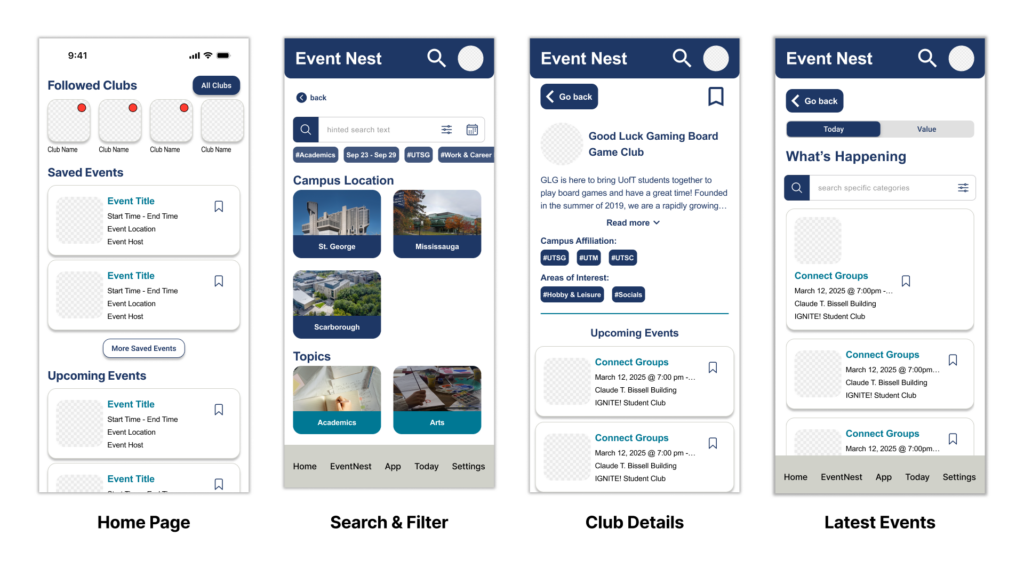
Due to the short time frame of the capstone and with client’s approval, we decided to start with a mid-fi designs in Figma. Using the identified opportunities above as a guide, this first iteration of the designs was made roughly so that we could start to collect feedback and iterate on ideas quickly.
Peer Feedback
As part of the capstone process, every group participated in a group feedback session with each other. Due to the nature of our project and target audience, this allowed us to gain more insights on how UofT students would interact with our initial designs. From this, we learned that our design had multiple accessibility and usability issues. Additionally, some features that the client wanted to be done a specific way were not intuitive. To remedy this, we organized a discussion with the client and advocated for a design that was better supported from user research.
My Contributions
- Led a discussion on the initial information architecture of the mobile app.
- Organized team meetings to discuss design decisions and coordinate work.
- Hosted and directed meeting with the client, gaining buy-in for design decision.
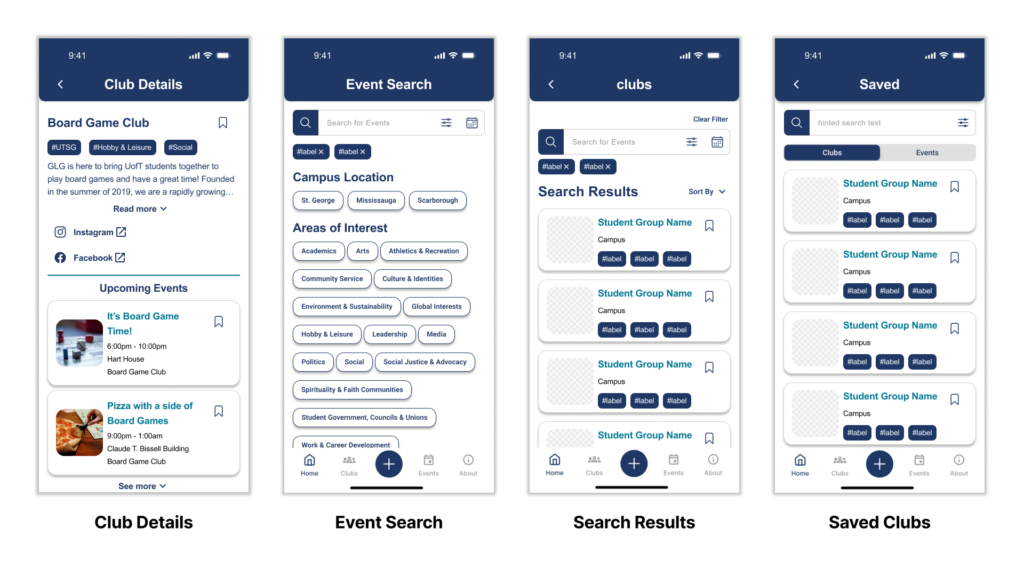
- Designed the initial Club Details, search, and filter result pages.
- Supported group members with their tasks.
Design: Round Two
After meeting with the client and discussing potential directions for the project, we were given approval to rework the information architecture of the EventNest feature and rework features to better suit user needs. We then created the second iteration of the designs.
User Feedback
To validate our design changes since round 1, four usability testing sessions were arranged with UofT students who have not participated in our initial user interviews. Participants were given 20 minutes to interact with our prototype and encouraged to think aloud while being observed. To encourage navigation, we presented them with general scenarios that student may encounter when using the app. Afterwards, a 8 minute post-activity discussion was used to help target specific action and thoughts they had during the session. While the app’s design was received positively by each participant, there were a few issues that needed to be addressed.
Synthesized Findings
- The calendar feature was not intuitive and took too many actions to complete
“The calendar is weird […] it shouldn’t be more than one click away […] right now it doesn’t make sense for me to click here and then here and here to see the results” -P02 - Confusion over searching and using the filter
“At first, I was confused when the search didn’t do anything right away […[ expected it to show results instantly or have a more obvious search button.” -P01 - Issues with clarity on the event detail page and missing important details
“Didn’t notice the RSVP link, but then realized it was there,” and later added, “If the RSVP is internal, then a button would feel cleaner and more user-friendly.” -P01 - Student group page was too cluttered, making it hard to scan for information
“If there’s a way to make it like there to be less text so close together.” -P04 - Participants found the Saved List feature to be useful, but had issues with navigation
“I like having multiple tabs open when researching something… I prefer to save clubs I’m interested in rather than click into each one.” -P04
“it’s weird that it’s here and not [where the ‘about’ tab is] at the bottom” -P02 - Navigation issues with locating EventNest features
“I kind of expected to start looking [where these tiles are] instead of down here [in the navigation bar] because everything is kind of drawing my attention here and I didn’t realize I should be looking down here instead” -P03
My Contributions
- Updated the information architecture based on discussion with the client and the needs of users.
- Reworked the Club Details, search, and filter result pages based on client and peer feedback.
- Conducted a usability test with a UofT student to gain qualitative data.
- Organized team meetings to discuss design decisions and coordinate work
- Hosted and directed meeting with the client, gaining buy-in for design decision.
- Supported group members with their tasks.
Prototype Deliverable
Hi-fi Prototype
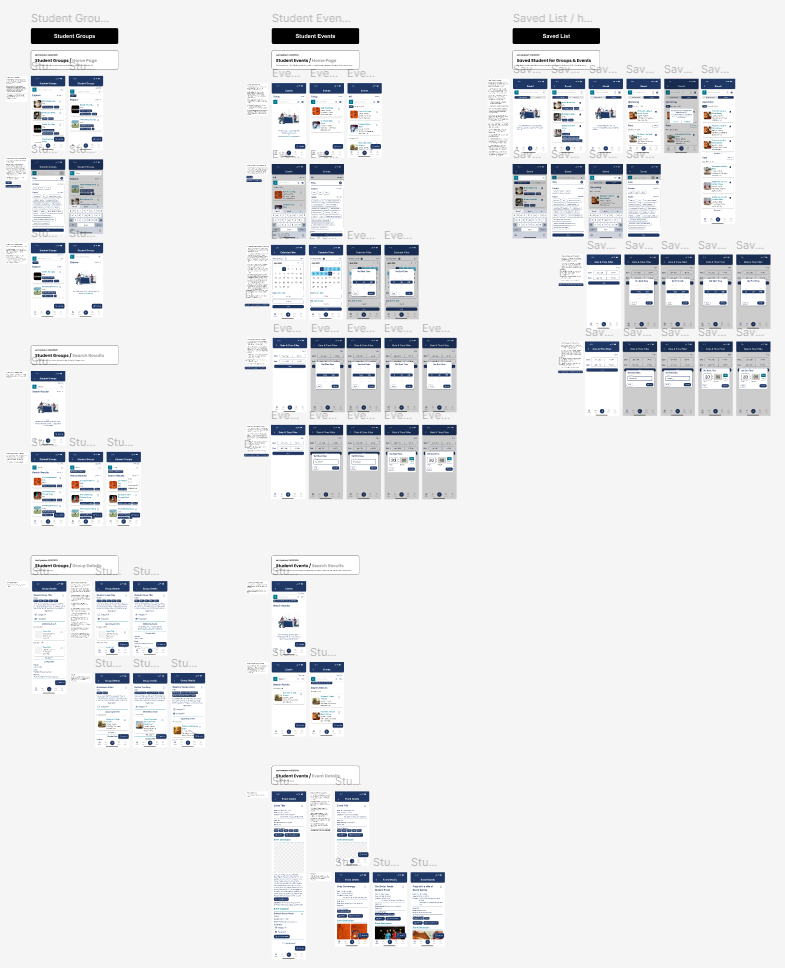
After analyzing the user feedback, we then created the hi-fi version of our designs and updated them to reflect user needs. As part of the deliverable expectations, an interactive prototype was created to showcase the mobile application flows and help with development.
If you would like to know more about the hi-fi prototype or interact with it, feel free to contact me!
Final Deliverable Contributions
- Created empty frames that showcase what should be displayed when there is no information or data that can be presented.
- Update designs based on user feedback in round 2 and client feedback.
- Revamped the entire calendar and time filter to better fit client goals.
- Helped create the Saved List button and its related pages.
- Ensured that every part of the designs were standardized and consistent with the design system
- Created the fully interactive prototype from the designs.
- Presented final deliverables to client and received approval of work.